What Is Agitprop? The Propaganda Framework That Still Shapes Politics Today
What Is Agitprop? Definition and Origins
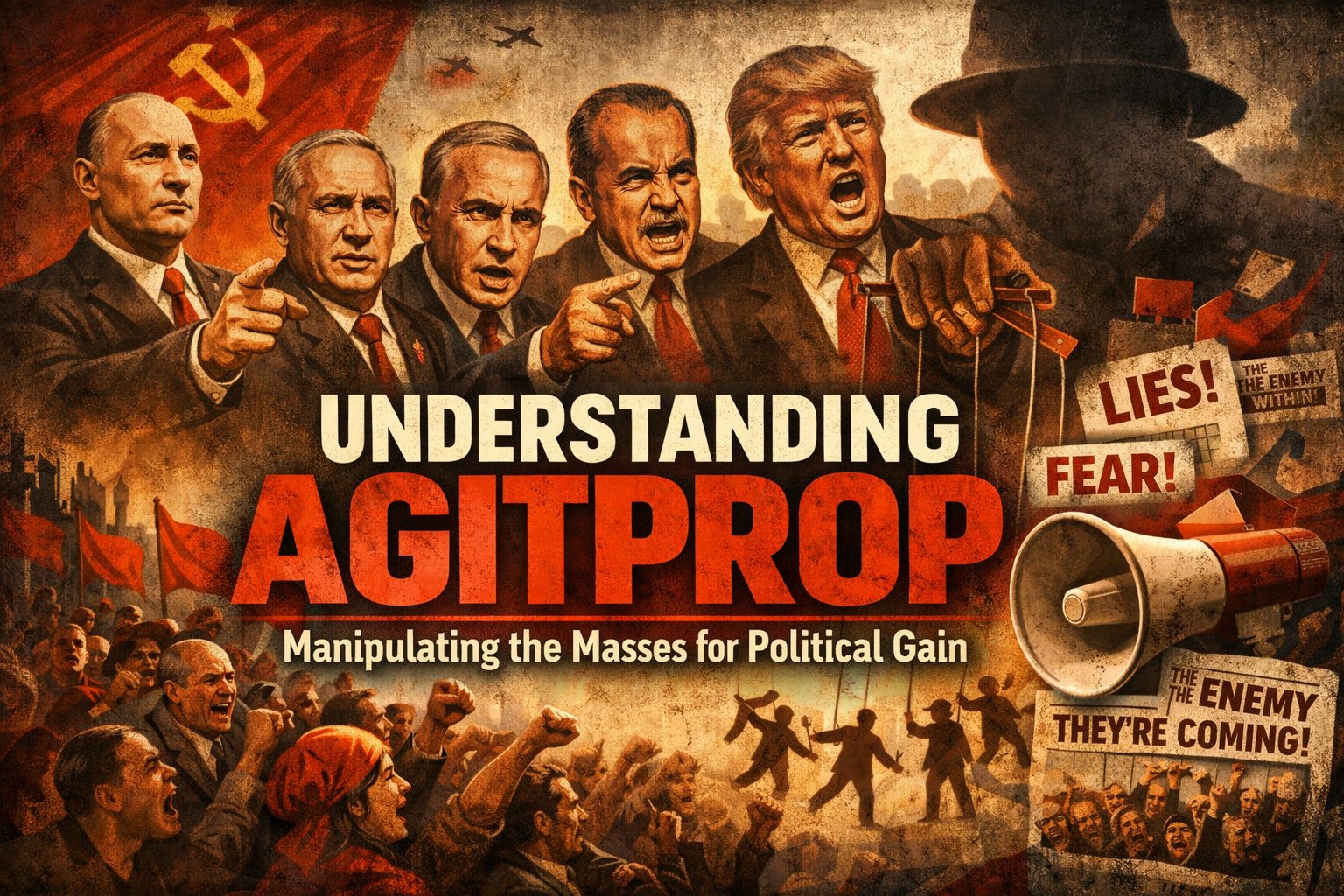
What is agitprop? Agitprop is a framework for convincing large numbers of people to do something. The term originated from the “Otdel Agitatsii i Propagandy“ (ie. literally, the Department of Agitation and Propaganda) established within the Central Committee of the Communist Party of the Soviet Union. It implies a coordinated system of messaging where truth is irrelevant and persuasion toward a hidden agenda is the only goal. It covers both ‘clever’ framing and outright lies.
Agitprop is a portmanteau of two Russian words:
Agitatsiya means agitation, from the Latin agitatio (to set in motion, to stir up). This referred to stirring up emotional responses in the public, appealing to feelings rather than reason.
Propaganda (which we borrowed from the Russians) comes from the Latin propagare (to spread or propagate). This referred to the broader ideological education and dissemination of doctrine.
So the word was literally an internal bureaucratic label that described the machinery of state-driven persuasion. It eventually entered English during the Cold War as a pejorative, losing its original technical distinction and coming to mean any coordinated system of politically motivated messaging where truth is subordinate to ideology.
Lenin discusses and explains agitprop in his book, What is to be done? and draws a sharp distinction between propaganda and agitation. Propaganda meant communicating many ideas to a small number of people; agitation meant communicating one or a few ideas to a large mass of people.
Propaganda: Communicating Many Ideas to Few People
Propaganda targets the people who are already asking “why.” Lenin’s example: a propagandist addressing unemployment must explain the capitalist nature of crises, why they are inevitable under the current system, and why the transformation of society is necessary. This requires presenting so many different interconnected ideas and only a comparatively small audience will absorb them as a coherent whole.
In practice, this looks like a study circle of ten steelworkers reading political economy together on weekends. It looks like a forty-page pamphlet explaining how commodity production leads to overproduction crises. It looks like a three-hour educational session at a union hall where a speaker walks through the relationship between wage labour, profit extraction, and recurring unemployment. The audience is small, but the goal is to produce people who can think structurally, see and explain the systemic nature of the issue, and defend and spread the ideas in the real world.
Lenin argued that the propagandist operates chiefly through the printed word: books, newspapers, long-form pamphlets; because the complexity of the message demands a medium the reader can sit with, re-read, and study. Remember he wrote this in 1902, far before social media, television etc.
Agitation: Emotional Manipulation of the Masses
Agitation targets the people who are feeling the problem but haven’t yet asked, or generally don’t ask, “Why?” They don’t need a theory of the crisis, an explanation of the reasoning or substantive verification, they just need someone to name what’s happening to them, incite their emotions and point them towards the actions. To use Lenin’s unemployment example – an agitator addressing the subject of unemployment takes a single widely known fact1 with potential emotional appeal, say, the death of an unemployed worker’s child from starvation or malnutrition and uses it to drive home one powerful idea to a mass audience.
In practice one doesn’t require the fact to be true or the grievance to be genuine2. All that is required for agitation is 3 things:
- a claim that triggers an emotional response,
- an identifiable enemy to blame, and
- an audience primed to receive the message.
Exaggeration, selective framing, outright fabrication, the agitator doesn’t need a real situation they just have to spark fear and outrage. Trump’s migrant caravans with unknown ‘middle easterners’, pre-midterm panic over ebola (but Covid was okay – I will never understand this level of intellectual dissonance and dishonesty), racist birther certificates are all examples of agitation.
Agitation works by triggering, fear, disgust, humiliation, rage etc. The agitator picks an emotion they deem to currently be (most) prominent in a population at a given time and attaches it to a target: the landlord, the foreigner, the bureaucrat, the party in power and frequently immigrants and other minorities. The idea shared isn’t an analysis or solution, often the idea would be counterproductive to the stated goals or desires, the idea is about focusing hate and suspicion on someone you don’t like and using that to motivate (or demotivate) action.
Is Agitprop Still Used Today? Modern Examples
Agitprop is widely used by right wing parties and conservatives today, in fact if you look at their actions through this framework, along with the racism and the religious sponsorship, everything makes perfect sense. Suddenly lying about the effects of tobacco, weapons of mass destruction, opposing civil rights protections, voting against equal pay for women, denying climate change, lying about immigrants, voter fraud, insisting HIV didn’t lead to AIDS, lying about drugs and the drug war all makes sense.
Frequently Asked Questions
What is agitprop?
Agitprop is a portmanteau of “agitation” and “propaganda,” originating from the Soviet Department of Agitation and Propaganda. It refers to a coordinated system of messaging where truth is irrelevant and persuasion toward a hidden agenda is the only goal, covering both clever framing and outright lies.
What is the difference between propaganda and agitation?
According to Lenin, propaganda means communicating many ideas to a small number of people (depth over reach), while agitation means communicating one or a few ideas to a large mass of people (reach over depth). Propaganda targets those already asking “why,” while agitation targets those feeling a problem but not analyzing it.
What are modern examples of agitprop?
Modern examples include Trump’s migrant caravan narratives featuring claims about “unknown middle easterners,” pre-midterm panic over Ebola, and the racist birther conspiracy. These follow the agitation pattern: a claim that triggers an emotional response, an identifiable enemy to blame, and an audience primed to receive the message.